

Researchers develop fire-retardant electrolyte for long-life high-voltage li-ion cells
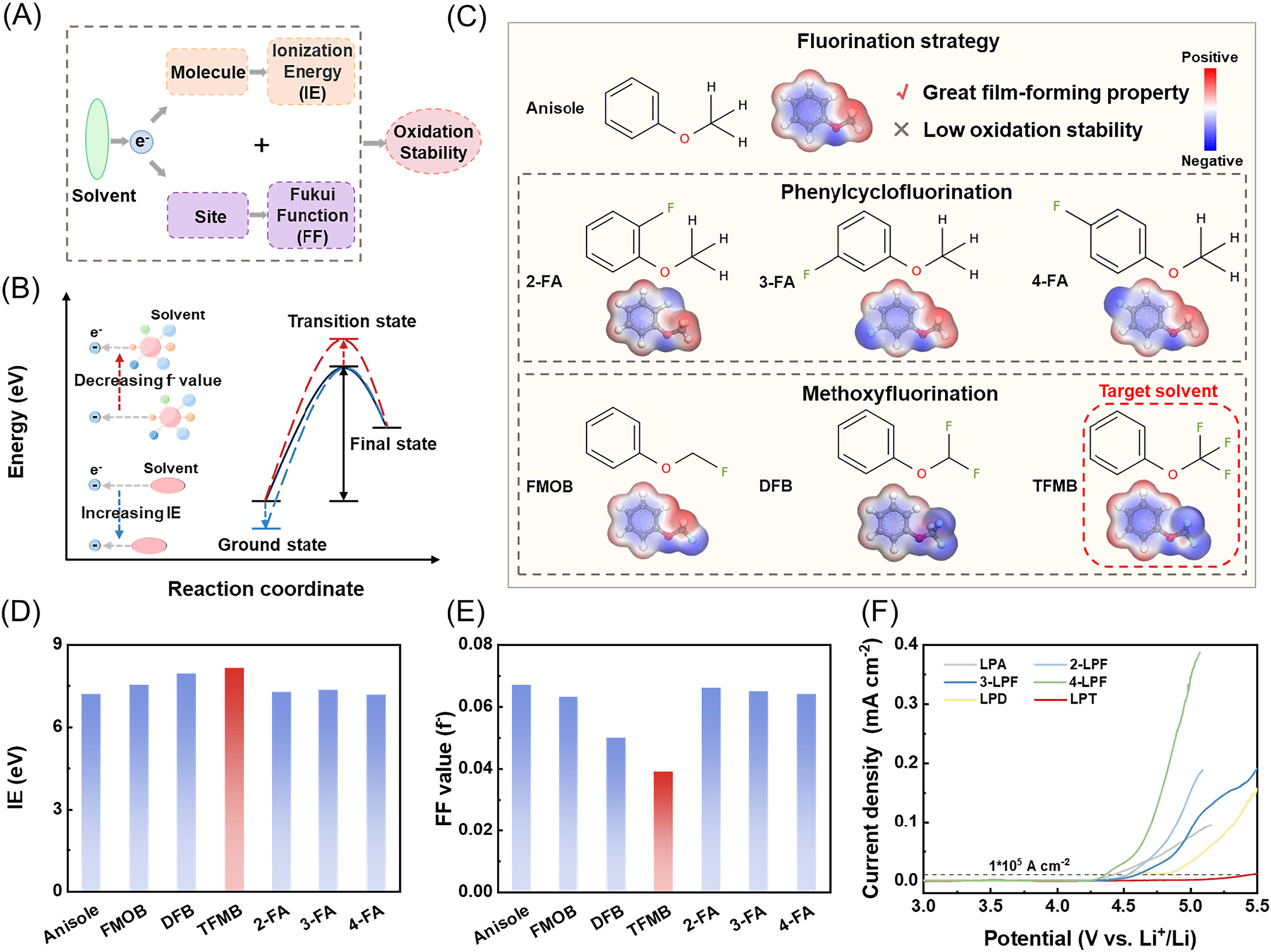
Local-to-Global Fluorination Framework Guides the Discovery of a High-Stability Solvent for High-Voltage Batteries. (A) Schematic diagram describing general guidelines for electrolyte design from the local sites and molecules. (B) Influence of IE and FF,
GA, UNITED STATES, December 15, 2025 /EINPresswire.com/ -- As the push for higher-energy lithium-ion batteries accelerates, developing electrolytes that remain stable at high voltages has become critical. This study presents a targeted solvent-fluorination approach that links molecular ionization energy with reactive-site mapping, allowing researchers to design safer, more resilient solvents. By screening anisole-based molecules, the team pinpointed (trifluoromethoxy)benzene (TFMB) as an exceptionally stable fluorinated solvent. Integrated into a new low-reactivity electrolyte (LPT), TFMB helps build strong protective interphases, broadens the voltage limit, and suppresses harmful oxidative reactions. With this LiPF₆–PC–TFMB LPT electrolyte, LiCoO₂ batteries maintained 78.8% capacity over 600 cycles at 4.5 V and showed substantially reduced heat and oxygen release—marking a practical step forward for safer high-voltage lithium-ion technologies.
Raising the cut-off voltage of lithium-ion batteries (≥4.3 V) can directly boost energy density, yet conventional carbonate electrolytes suffer from oxidative decomposition, unstable cathode–electrolyte interfaces, and severe structural degradation under these conditions. Emerging electrolyte engineering strategies—such as high-concentration electrolytes, localized high‐voltage cathode (HCE) systems, and functional additives—have shown promise but often face trade-offs in viscosity, cost, interfacial stability, and safety. Fluorinated solvents are promising because strong C–F bonds improve oxidation tolerance and suppress flammability, but their performance depends heavily on precise fluorination degree and substitution site. Due to these challenges, a systematic method is needed to design and evaluate fluorinated solvents for high-voltage applications.
Researchers from Zhejiang Sci-Tech University and collaborating institutions reported on October 31, 2025, in Carbon Energy a local-to-global solvent-fluorination strategy that enables the rational design of high-voltage electrolytes. By combining ionization-energy analysis with Fukui-function mapping, the team screened anisole-derived fluorinated molecules and identified (trifluoromethoxy) benzene (TFMB) as an optimal low-reactivity solvent. The resulting LiPF₆–PC–TFMB low reactivity solution (LPT) electrolyte demonstrated exceptional high-voltage stability in LiCoO₂ cells, significantly enhanced interfacial robustness, and improved thermal safety characteristics compared with conventional carbonate systems.
The authors first established a screening descriptor that integrates ionization energy (IE)—reflecting molecular ground-state stability—and the Fukui function (FF), which maps local reactive sites susceptible to oxidative attack. Solvents with high IE and low FF values were predicted to resist oxidation more effectively. Using anisole as a model, they evaluated fluorination at various molecular sites and degrees, eventually identifying (trifluoromethoxy) benzene (TFMB) as the best candidate due to its highest IE and minimal reactive-site activity.
The TFMB-based electrolyte (LPT), blended with propylene carbonate and LiPF₆/LiBOB salts, exhibited a broader electrochemical window (>5.41 V) and superior oxidative stability compared to commercial carbonate electrolytes. Molecular dynamics simulations and NMR analyses revealed a contact-ion-pair–dominated solvation structure in LPT, where TFMB remains outside the primary Li⁺ solvation shell but stabilizes interfacial chemistry through dipole-dipole interactions.
Electrochemical tests demonstrated that LPT enables LiCoO₂ (LCO) cells to maintain 78.8% capacity after 600 cycles at 4.5 V, outperforming the rapid degradation observed in commercial electrolytes. XPS and TOF-SIMS analyses further showed that LPT forms a thinner, inorganic-rich CEI layer dominated by borates and carbonates, suppressing solvent decomposition, Co dissolution, microcrack formation, and irreversible O3→H1-3 phase transitions. Thermal and safety tests confirmed significantly reduced heat release, oxygen evolution, and flammability, confirming the electrolyte’s robustness.
“Our findings demonstrate that high-voltage electrolyte design can be fundamentally improved by combining global electronic stability with site-specific reactivity analysis,” the authors noted. “The TFMB-based LPT electrolyte showcases how precise fluorination can simultaneously enhance oxidation resistance, stabilize cathode interfaces, and mitigate safety hazards. This dual-scale framework provides a predictive path to designing next-generation solvent systems, moving beyond traditional trial-and-error approaches. We believe such rational strategies will accelerate the development of safer, longer-lasting lithium-ion batteries capable of operating under increasingly demanding voltage conditions.”
The proposed screening strategy and the successful LPT electrolyte highlight a practical route to achieving safe, high-voltage, flame-retardant lithium-ion batteries without compromising cycle life or energy density. By reducing electrolyte decomposition, suppressing cathode structural degradation, and mitigating thermal runaway precursors such as heat release and oxygen evolution, the approach promises improved reliability in electric vehicles, high-power portable devices, and grid-scale storage. The integrative IE-FF framework also provides a generalizable tool for designing next-generation fluorinated solvents, enabling more efficient discovery pipelines for high-performance electrolyte systems in both lithium-ion and emerging battery chemistries.
References
DOI
10.1002/cey2.70109
Original Source URL
https://doi.org/10.1002/cey2.70109
Funding information
The National Natural Science Foundation of China (22522814, 22278378, and 52402318);
Zhejiang Provincial Natural Science Foundation of China (LDQ24E030001 and LQN25E020003); Science Foundation of Zhejiang Sci-Tech University (22212011-Y and 24212149-Y).
Lucy Wang
BioDesign Research
email us here
Legal Disclaimer:
EIN Presswire provides this news content "as is" without warranty of any kind. We do not accept any responsibility or liability for the accuracy, content, images, videos, licenses, completeness, legality, or reliability of the information contained in this article. If you have any complaints or copyright issues related to this article, kindly contact the author above.
