

Fringe Projection Profilometry Enters the Era of Intelligent Perception
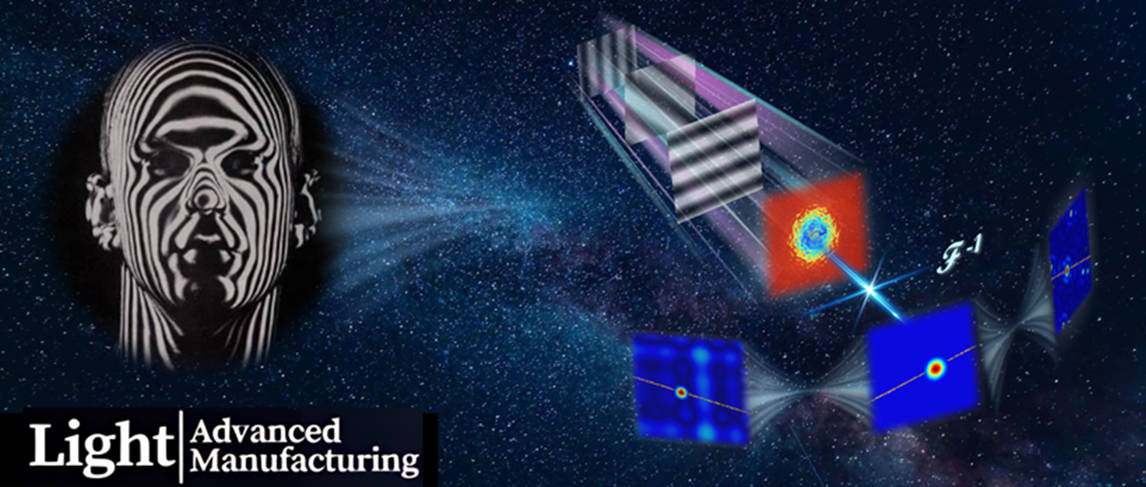
Paradigm shift from geometric triangulation toward computational 3D imagin
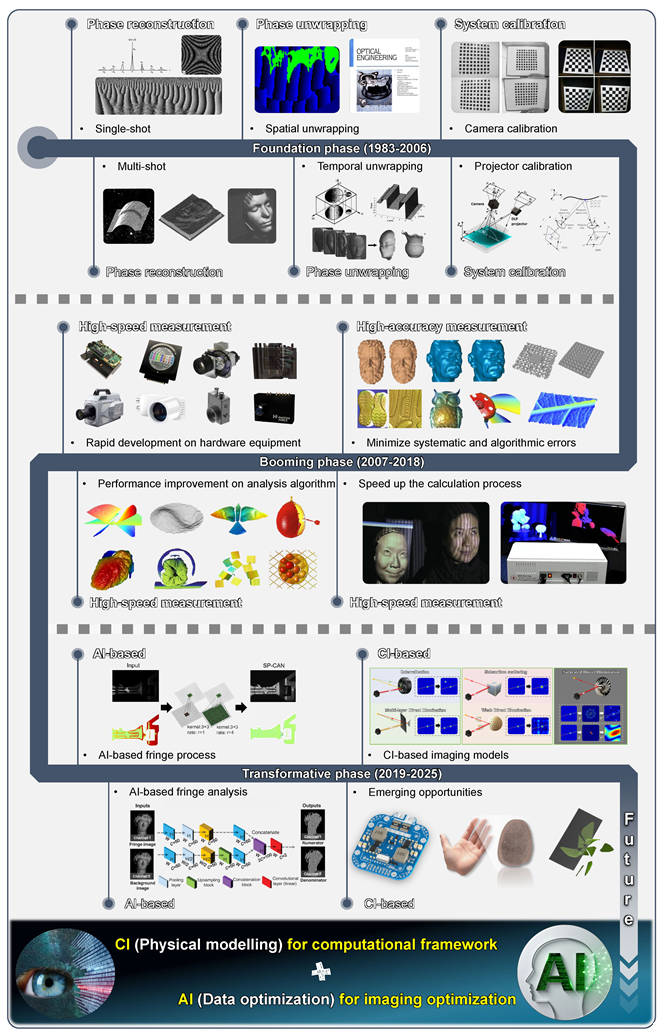
Development roadmap of fringe projection profilometry
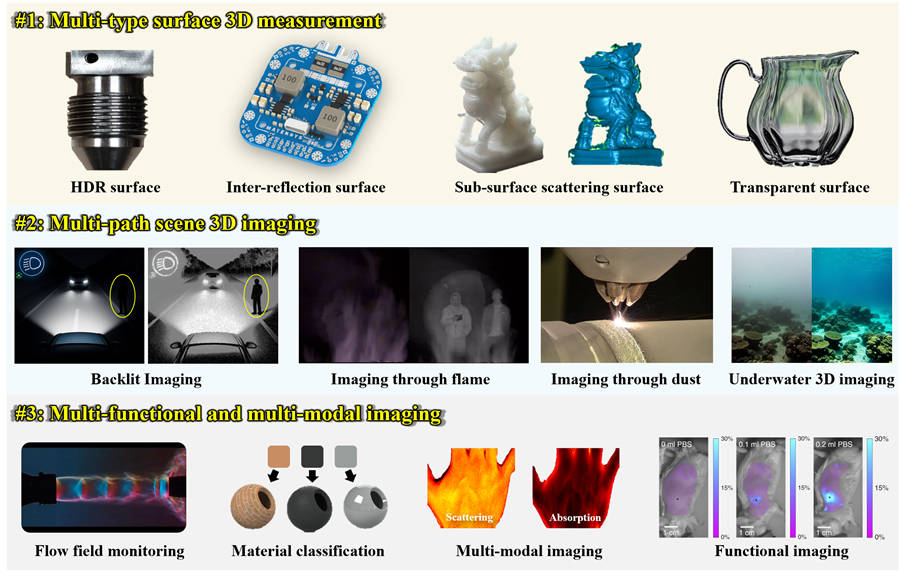
Current challenges and future directions for 3D imaging
GA, UNITED STATES, June 9, 2026 /EINPresswire.com/ -- Three-dimensional (3D) vision is undergoing a profound transformation. Recently, Zhoujie Wu and Qican Zhang from Sichuan University, together with Gunther Notni from the Fraunhofer Institute for Applied Optics and Precision Engineering IOF, published a review paper in Light: Advanced Manufacturing to systematically summarize over four decades of development in fringe projection profilometry (FPP) and reveal a paradigm shift from traditional geometric triangulation toward computational 3D imaging.
· From Measuring 3D to Understanding 3D
Since its inception in the early 1980s, FPP has been fundamentally built upon geometric triangulation. By projecting structured fringe patterns onto an object and analyzing the resulting phase information, the system reconstructs the three-dimensional shape of the target. This framework has enabled remarkable advances in industrial metrology, intelligent manufacturing, and scientific research.
However, conventional FPP relies on the assumption that the captured signal mainly originates from direct surface reflections. In real-world scenarios involving highly reflective materials, translucent media, biological tissues, and complex environments, light propagation becomes significantly more complicated due to multiple reflections, subsurface scattering, and other global illumination effects. Under such conditions, the recorded measurements contain not only geometric information but also rich information about the underlying light transport process.
The authors argue that future 3D vision systems must answer a fundamentally different question. Rather than asking simply “Where is the object?”, the next challenge is understanding “How does light propagate through the scene?”. This shift extends the focus of 3D vision from geometric reconstruction to light transport analysis, marking the transition from measuring 3D to understanding 3D.
· Computational 3D Imaging Opens a New Direction
According to the review, the evolution of FPP can be divided into three stages: the Foundation Phase (1983–2006), the Booming Phase (2007–2018), and the Transformative Phase (2019–present) as shown in Fig. 2. The foundation phase established the theoretical framework of FPP, while the booming phase focused on improving measurement accuracy, speed, and hardware performance, driving the technology from laboratory research to widespread industrial deployment.
Today, the field is entering a transformative stage. As 3D sensing applications expand toward extreme scales, dynamic scenes, diverse materials, and challenging environments, many longstanding limitations can no longer be overcome simply through incremental performance improvements. Framework innovation is becoming the new driving force.
In this context, artificial intelligence (AI) and computational imaging (CI) are opening unprecedented opportunities. AI offers powerful capabilities for solving complex inverse problems, while CI introduces higher-dimensional physical models to describe light–matter interactions. Their convergence is driving FPP beyond traditional geometric triangulation toward a new computational 3D imaging framework.
Original Source URL
https://doi.org/10.37188/lam.2026.074
Funding information
This research was supported by the National Natural Science Foundation of China (62575193, 62575192, 62505076, and 62205226), the National Postdoctoral Program for Innovative Talents of China (BX2021199), the General Financial Grant from the China Postdoctoral Science Foundation (2022M722290), and the Key Science and Technology Research and Development Program of Jiangxi Province (20224AAC01011).
Lucy Wang
BioDesign Research
email us here
Legal Disclaimer:
EIN Presswire provides this news content "as is" without warranty of any kind. We do not accept any responsibility or liability for the accuracy, content, images, videos, licenses, completeness, legality, or reliability of the information contained in this article. If you have any complaints or copyright issues related to this article, kindly contact the author above.
