

SICH Toilet Anxiety Research Project reveals long delay in sufferers seeking help for misunderstood condition
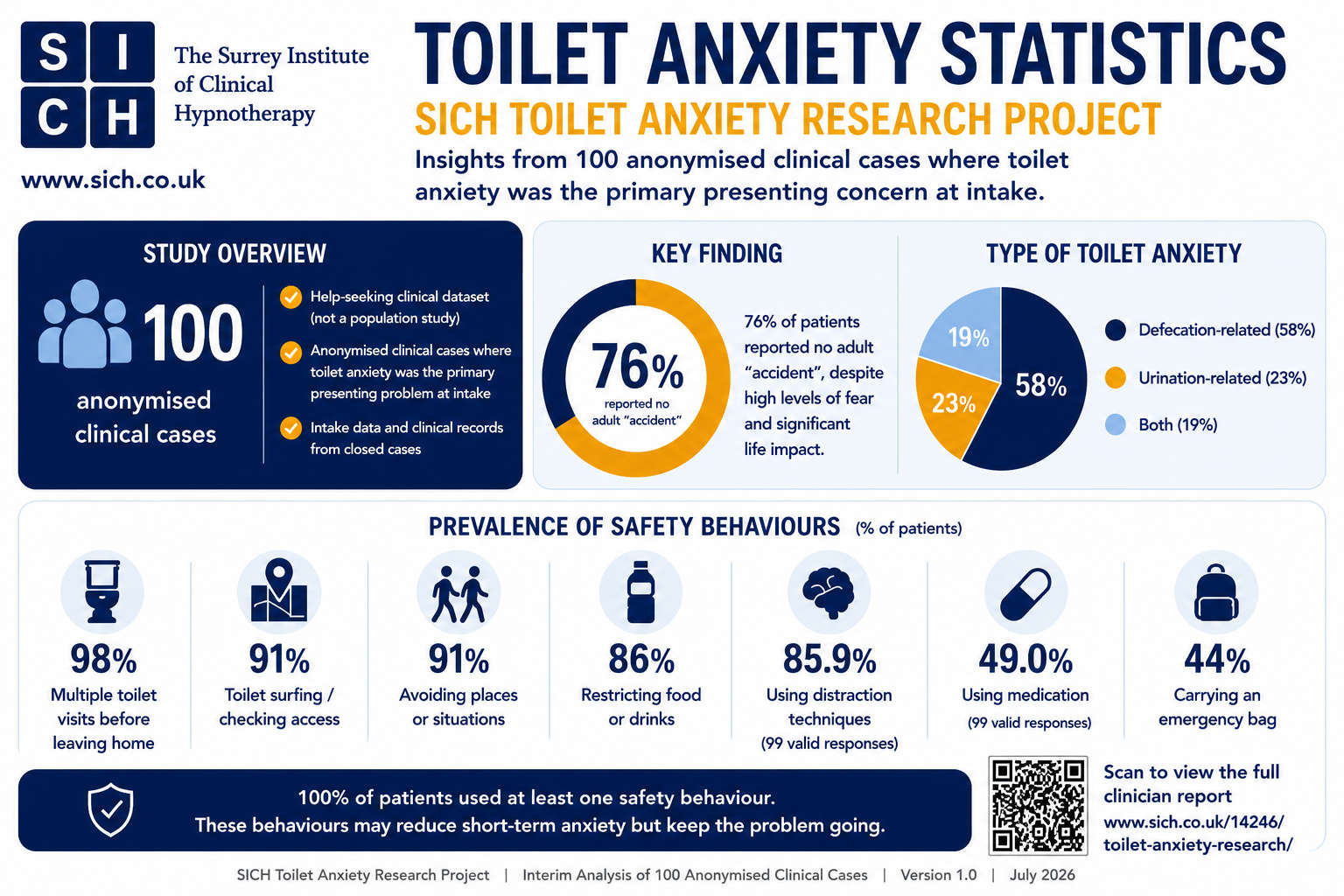
SICH Toilet anxiety research project findings at a glance
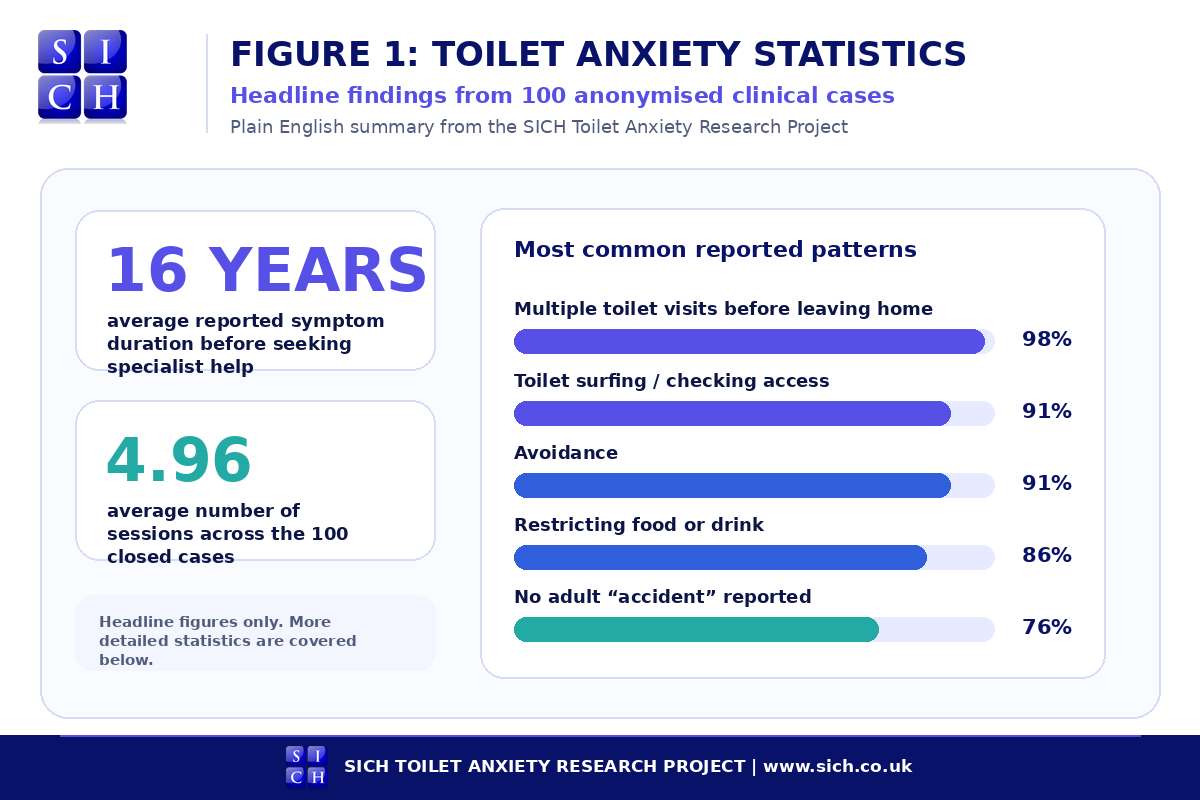
Toilet Anxiety Headline Statistics from the SICH Toilet Anxiety Research Project, based on 100 anonymised clinical cases.
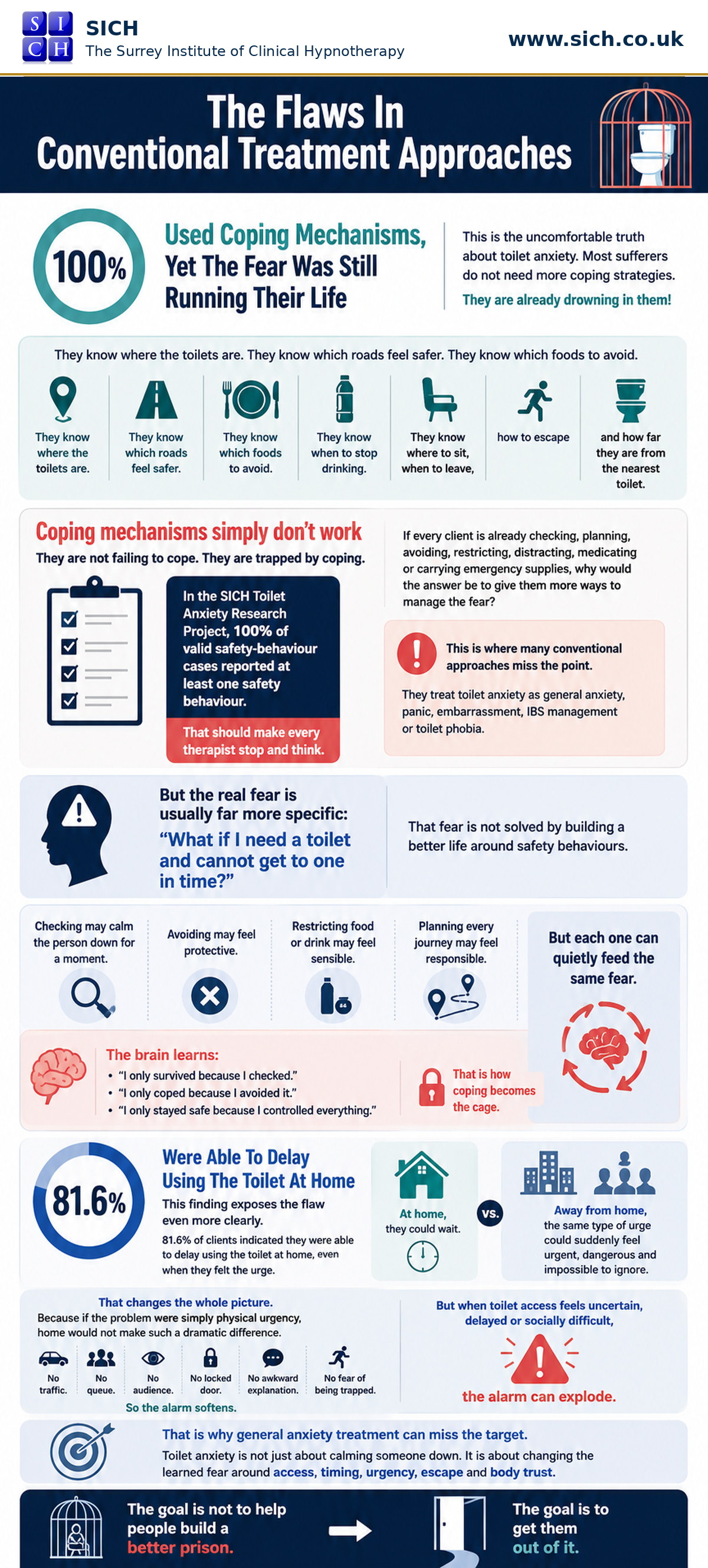
Coping Becomes The Cage infographic from SICH, showing how safety behaviours can maintain toilet anxiety rather than resolve it.

The Surrey Institute of Clinical Hypnotherapy, SICH, specialises in anxiety-related conditions, including toilet anxiety.
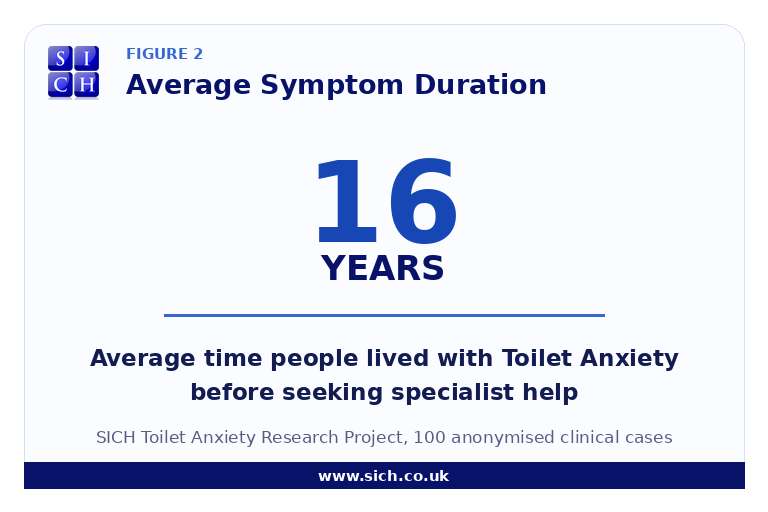
Symptom duration findings from the SICH Toilet Anxiety Research Project, showing how long clients had lived with toilet anxiety before seeking specialist help.
Analysis of 100 anonymised clinical cases found 76% of clients had never had an adult “accident”, yet all 100 used at least one coping or safety behaviour.
LONDON, LONDON, UNITED KINGDOM, July 3, 2026 /EINPresswire.com/ -- Led by specialist hypnotherapist Paul Howard, the project found that clients had lived with toilet anxiety for an average of 16 years before seeking specialist help.
Surrey, UK, 3 July 2026, The Surrey Institute of Clinical Hypnotherapy, SICH, has announced findings from the SICH Toilet Anxiety Research Project, based on 100 anonymised completed or closed clinical cases where toilet anxiety was the primary presenting problem.
The project has been led by Paul Howard, Senior Partner and Toilet Anxiety Specialist at SICH, who has spent more than 20 years treating toilet anxiety and has worked with thousands of clients affected by the condition.
For the past decade, Howard has focused his clinical practice almost entirely on toilet anxiety, working with clients whose lives have become restricted by urgency, access-checking, avoidance and fear of not making it in time.
Howard has pioneered a specialist approach focused on helping clients change the learned responses, safety behaviours and beliefs that keep toilet anxiety in place.
Howard says the project aims to correct a common misunderstanding.
“Toilet anxiety is not fear of toilets. That is toilet phobia. Toilet anxiety is the fear of needing a toilet and not being able to get to one in time,” said Howard.
“Most clients I see are not afraid of the toilet itself. They are afraid of being trapped, delayed, too far from a toilet, unable to leave, or uncertain whether access will be available when they need it.”
One of the most striking findings was that 76% of clients reported never having had an adult “accident”, yet all 100 clients used at least one coping or safety behaviour. SICH says this challenges the assumption that toilet anxiety is usually driven by repeated loss of control. Instead, the data suggests that for many people the anxiety is maintained by anticipation, access-checking, avoidance and the constant attempt to prevent a feared emergency.
Key findings include:
* Average symptom duration was 16 years
* 76% reported never having had an adult “accident”
* 9% had a recorded IBS or physical diagnosis in the clinical dataset
* Defecation-related toilet anxiety was the most common presentation, recorded in 58% of cases
* 98% reported multiple toilet visits before leaving home
* 91% reported checking toilet access or “toilet surfing”
* 91% reported avoidance
* 86% reported restricting food or drink
* Medication use was recorded in 49.0% of valid cases
* All 100 clients used at least one coping or safety behaviour
Further toilet anxiety statistics from the project are available on the SICH website.
Howard said:
“The striking part of this research project is not just that so many clients had not had an adult accident. It is that every client in the dataset was using at least one coping or safety behaviour.
“That matters because their lives had become organised around preventing something most had not actually experienced as adults.
“Most people with toilet anxiety are not being irrational in the way outsiders sometimes assume. They are trying to feel safe. The problem is that the very things they do to feel safe can start to shrink their life.
“At SICH, we do not treat toilet anxiety by giving people more coping techniques. For many clients, coping and avoidance behaviours are part of the problem. They can keep teaching the brain that ordinary situations are dangerous unless the person stays in control, checks access or has an escape plan.”
The project also found that 90% of clients reported no problem at home, while 84.8% of valid responders said they were able to put off going to the toilet in at least some situations. SICH says these findings support the view that toilet anxiety is often linked to access, uncertainty and being away from safety, rather than the basic act of using the toilet.
Toilet anxiety can coexist with physical bowel or bladder conditions. People with new, persistent or unexplained bowel or bladder symptoms should seek medical advice. The SICH Toilet Anxiety Research Project concerns clients where toilet anxiety was the primary presenting problem and should not be read as a substitute for medical assessment.
The full research page is available at:
https://www.sich.co.uk/14246/toilet-anxiety-research/
About The Surrey Institute of Clinical Hypnotherapy
The Surrey Institute of Clinical Hypnotherapy, SICH, is a UK hypnotherapy clinic specialising in anxiety-related conditions, including toilet anxiety, panic, phobias, confidence issues and stress-related problems. The clinic is based in Surrey and works with clients using a practical, present-focused clinical hypnotherapy approach.
Website: www.sich.co.uk
Mr Paul Howard
The Surrey Institute of Clinical Hypnotherapy
+44 20 8669 6990
email us here
Visit us on social media:
Facebook
YouTube
Paul Howard explains why common toilet anxiety coping strategies can keep you trapped, and how specialist hypnotherapy takes a different approach.
Legal Disclaimer:
EIN Presswire provides this news content "as is" without warranty of any kind. We do not accept any responsibility or liability for the accuracy, content, images, videos, licenses, completeness, legality, or reliability of the information contained in this article. If you have any complaints or copyright issues related to this article, kindly contact the author above.
