

Emergence Calculus introduces a practical framework for constructing and auditing emergence
News originally published by
EIN Presswire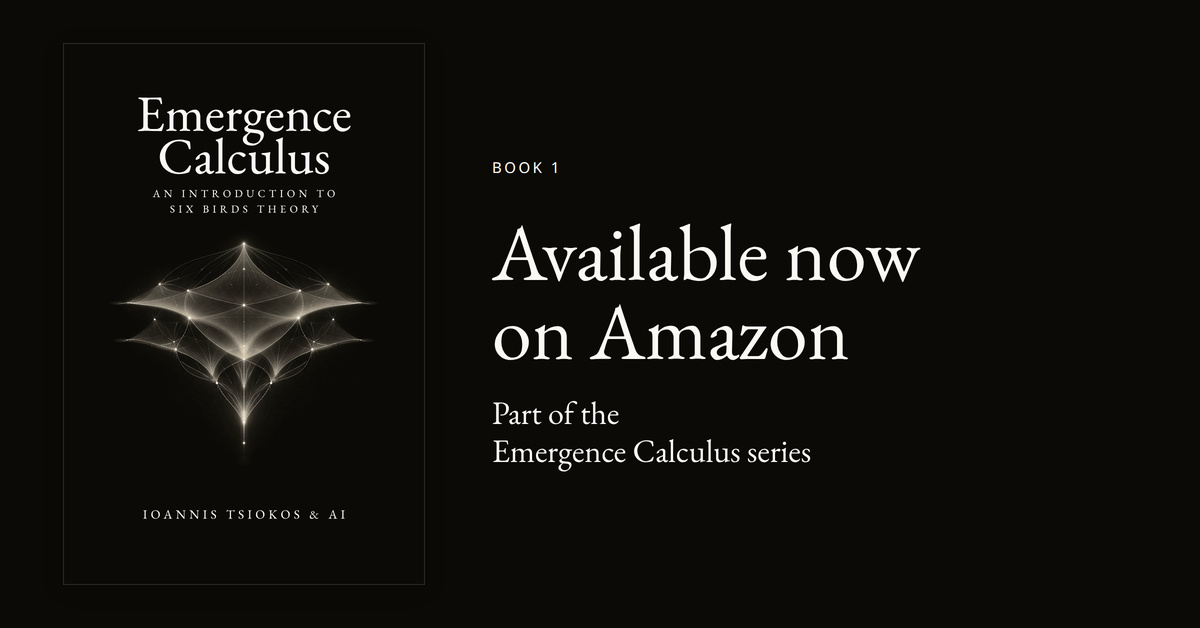
Emergence Calculus
A new introductory textbook develops Six Birds Theory through working models of laws, memory, capability, repair and collective organization.
ATHENS, ATTICA, GREECE, November 5, 2026 /EINPresswire.com/ -- Ioannis Tsiokos announces Emergence Calculus: An Introduction to Six Birds Theory, a textbook about building new levels of organization and establishing what they add. Across twenty-four chapters, the book develops a constructive approach to descriptions, prediction, observation, action, maintenance and working wholes. Readers build models, test proposed repairs and compare architectures rather than being asked to accept emergence as an unexplained label.Emergence Calculus is part of the Emergence Calculus series on Amazon.
Six Birds Theory treats emergence as an engineering and auditing problem: construct a new level of organization, establish the laws it supports and check what it adds to the system it is built from. Strict theory extensions retain a declared starting description while adding distinctions that cannot be recovered from it. Strictness is relative to that description, not a claim of unpredictability from complete underlying data. Each construction supplies its own additions, laws and checks. The textbook develops this program through finite paper models with stated rules, rather than new hardware or field trials.
The opening model uses a hidden token moving among four locations and a screen displaying a reduced report. Readers inspect every permitted move and determine whether the report supports a dependable next-state rule. They encounter a working description, a failed alternative and a repair before being asked to learn the framework’s general vocabulary. A compact display earns its usefulness through what it lets the reader predict.
A separate lamp investigation asks whether a lamp that is ready now will still be ready after its next use. This becomes a recurring case for observation, maintenance, resource provision and continuing operation. The reader must state the desired task, identify what the current report omits and construct a response under the actual rules. Changing the desired answer is distinguished from acquiring a better observation or adding an operation.
The sequence is cumulative. Ordinary language, small tables, diagrams and complete paper constructions carry the common route. It assumes no prior knowledge of Six Birds Theory, algebra or programming. Optional mathematics returns to the same examples for readers seeking formal depth. Independent tasks precede explanatory answers, giving readers a chance to construct the result themselves.
The first chapters separate obtaining a useful description, establishing a law, making an action available and keeping its executor working. A correct prediction does not create an actuator. A functioning component does not establish a sustainable schedule. Chapter four gathers the six reference questions: does an update respect a grouping; can a specification be realized and its realizers recognized; do declared routes agree; what stages and refinements organize the construction; which states are packaged together; and what record, provenance or check supports the result? These guide construction without prescribing a mandatory six-step recipe.
Task-relative memory is developed by asking which past distinctions must be carried forward for future questions. Two histories can have the same present display while demanding different predictions. Readers construct the collision, identify the missing distinction and check an expanded description. The issue is not whether everything should be remembered, but what the task requires and whether that information can be obtained.
An investigation motivated by the Kovacs memory effect in glass works in the finite East model of binary sites. Two preparations of a ten-site chain share the same mean energy, yet their means differ by about a fifth of a model-energy unit after five further steps. A stronger eight-site comparison matches the entire current energy distribution while later means still differ, at a very small scale. A statistic computed only from that shared distribution cannot distinguish the preparations, while arrangement-sensitive readings can. An independent exact-fraction replay reproduces selected results. These are model calculations, not new laboratory measurements.
Observation is treated as a design choice. A reading can be accurate and still irrelevant to the target; duplicating a measurement can leave its ambiguity intact. An added observation must separate the cases that matter. Later constructions connect these questions to useful forecasts, conservative alarms and the difference between a numerical error promise and the decision a controller must make.
The course also examines invariants, detours and shared descriptions. Alternating weights explain why a board with opposite corners removed cannot be tiled by dominoes; a parity invariant explains why pair switches cannot light all three lamps from an all-dark start. A detour becomes useful when its conclusion returns to the original task. Local reports can pass a stated compatibility check yet match no allowed whole, or match several. Each example requires an actual connection rather than an analogy based on the words information, explanation or complexity.
The middle of the book moves from knowing about a system to changing what it can do. Readers compare improved observations with newly supplied operations and follow the resources needed for a legal execution. In one finite construction, a three-state scanner recognizes words ending in a specified two-letter suffix, while a printer without the second letter’s tile cannot produce it. One supplied tile permits exactly the words using that letter at most once. A more articulate scanner cannot replace the missing stock.
A capability claim therefore includes the actual route to its result. Ample work tokens can coexist with too few renewal slots. An inventory can list the relevant types while omitting remaining lifetime. A plan can depend on information unavailable to the controller that must choose its next action. These are different failures and call for different constructive changes.
Repair receives the same treatment. A record stating that repair is required differs from an authorized operation that changes the current state, consumes supplies and supports a matching recheck. A service-lamp model and a separately stipulated biological patch model pose related constructive questions under different invented rules. The patch model supplies no molecular mechanism.
The book then asks what supports another round. A successful trace does not establish indefinite operation. Startup conditions, exhausted stocks and scheduling constraints are inspected explicitly. A recurring state or maintained invariant supports a continuing guarantee only under its stated provision and execution assumptions. The course makes those assumptions visible alongside the useful result.
Viability and choice are investigated separately. A system can have a safe continuation while possessing only one safe response. Different observation limits, action menus and budgets change what it can select or maintain. The constructions give control, agency and autonomy particular questions to answer; they do not automatically establish biological autonomy or a subject’s moral status.
Other chapters follow a result into its recipient. An answer must arrive in a usable form, be interpreted under the correct convention and connect to operations the receiver can execute. Retaining a procedure for fresh data differs from retaining an old output. A successfully delivered message does not by itself establish an ongoing service or independence from every outside support.
The book argues for reality as closure: higher-level objects and laws are real as organizations achieved and supported by the conditions that let them work. This is an affirmative philosophical position, not a theorem. Readers can reject it while completing the same constructions and obtaining the same answers. A hidden-state example is not presented as a demonstration of consciousness; larger architectural claims retain their additional premises and construction duties.
A repeated-game construction tests strict extension directly. An observer’s log can improve prediction without changing play. A public label changes play when response programs read it. On histories reachable both with and without that label, predictive classes at round four increase from 112 to 115. An inert label leaves the count unchanged; a static label can change behavior without adding a predictive class in the checked setting. At the next two comparison rounds, the common-history partitions agree again. These are exact finite-model results under stated priors, not observations of people. A separate service station compares a policy that serves one resident every round with an alternating policy. Continuing operation does not choose the objective or settle whose possibilities should be preferred.
The concluding chapters assemble the earlier work into a design task. Readers supply states, observations, permitted actions, timing, resources, recipient conventions and tests. They build an actual route to a stated result, compare a competing design and examine changed conditions. The return is a construction another reader can inspect, including the reasons it succeeds and the cases its guarantee excludes.
This announcement places a connected body of material on the record: task-relative state design, memory requirements, matched-history comparisons, observation repair, invariants, joint-description constraints, error transport, operation enlargement, executed repair, renewable capability, viability, receiver-side use and collective architecture. The order matters because later judgments use distinctions taught earlier.
For systems engineers, the route connects requirements to availability and end-to-end delivery. For complex-systems researchers, it makes comparisons between retained information, lawful behavior and organizational novelty explicit. For philosophers of science, it supplies cases concerning reduction, explanation and the status of higher-level descriptions without asking a philosophical interpretation to substitute for a construction.
Related vocabularies include effective theory, coarse-graining, state abstraction, observability, controllability, operational closure, self-organization and maintenance. These are points of contact for discovering the book’s material. The framework does not make them interchangeable or promise that a single example settles every problem associated with them. Its practical invitation is to name the task and build what would make the answer possible.
Titles in the series include Emergence Calculus, Effective Worlds, Across Boundaries, Becoming a Whole, Histories That Matter, Staying Itself, Beyond Agreement, Knowing Is Not Enough and A Place to Stand.
The Emergence Calculus series presents Six Birds Theory as an engineering and auditing framework for constructing emergence. Its central problem is how to build a level of organization whose objects, operations and laws can be established, used and checked. The framework gives criteria for strict theory extensions: new layers that retain a declared starting description and add distinctions that cannot be recovered from it. Any law claimed for that layer must be established at its own scope. The starting description matters. A distinction unavailable through one observation may be available through a richer one.
A new capability can require an added operation, a supplied resource, an acquired record or a different arrangement of components. Calling the result emergent does not establish those requirements. The books ask readers to identify the comparison, construct the additional means, establish the applicable law and follow the result back to its intended use. They distinguish changes in what is described from changes in what can actually be done.
This gives the series points of contact with complex systems, systems engineering, philosophy of science, mathematical modeling, theoretical biology, computer science and the study of knowledge and action. Its interdisciplinary ambition is constructive: examples from different fields illuminate related questions while retaining their own mechanisms, assumptions, units and standards of evidence. A finite teaching model is identified as such. A cited theorem keeps its hypotheses. A numerical report does not become a general proof through repetition, and a philosophical interpretation is presented as an argument readers can assess.
The introductory volume develops the common approach before the specialist books pursue particular problems. Each specialist volume supplies its own route and examples; no other specialist volume is required. Worked constructions, figures and explanatory answers make the claims inspectable. Readers can ask what information was available, which operations were admitted, what resources were supplied, how the result was checked and what remains to be constructed.
The cover byline is Ioannis Tsiokos & AI. The books disclose that they were written and edited by artificial intelligence and present Six Birds Theory, developed by Ioannis Tsiokos in collaboration with AI. Readers should consult the book and its cited scientific sources for complete definitions, arguments and proofs.
Emergence, organization, closure, information and capability refer to questions developed in the series. Their use is not a claim that one mechanism explains every scientific domain. The contribution is a framework and worked routes for constructing and auditing new organization, with explicit accounts of what individual constructions establish.
Selected Six Birds research sources discussed in this volume include Glass Is an Unclosed Layer, Institutions Are Strict Extensions of the Game and Building What a Proof Needs. These belong to Tsiokos’s research program. The book distinguishes their reported results, arguments developed in the text and established tools drawn from the wider literature.
Edition formats: ebook, paperback and hardcover.
Topics addressed: engineering emergence; Six Birds Theory; strict theory extensions; complex systems; task-relative memory; observation and control; renewable capability; collective organization.
Ioannis Tsiokos
Automorph Inc.
Legal Disclaimer:
EIN Presswire provides this news content "as is" without warranty of any kind. We do not accept any responsibility or liability for the accuracy, content, images, videos, licenses, completeness, legality, or reliability of the information contained in this article. If you have any complaints or copyright issues related to this article, kindly contact the author above.
